Extended ER Feature
Two important concept in ER model -specialization and generalization

Learning by building | Exploring core CS, sharpening DSA skills, and creating modern web apps.
Int his article I have provided an overview of the ER Extended feature concept, detailing its utilization, implementation, and its significance in advanced entity-relationship modeling.
1. Specialization
Specialization is an extended ER feature used when the complexity of a system increases and a normal/basic ER diagram is not sufficient to represent all requirements clearly.
Explanation-When an entity has too many attributes, it may lead to redundancy and poor design. In such cases, the entity can be broken down into sub-entities based on roles or characteristics.
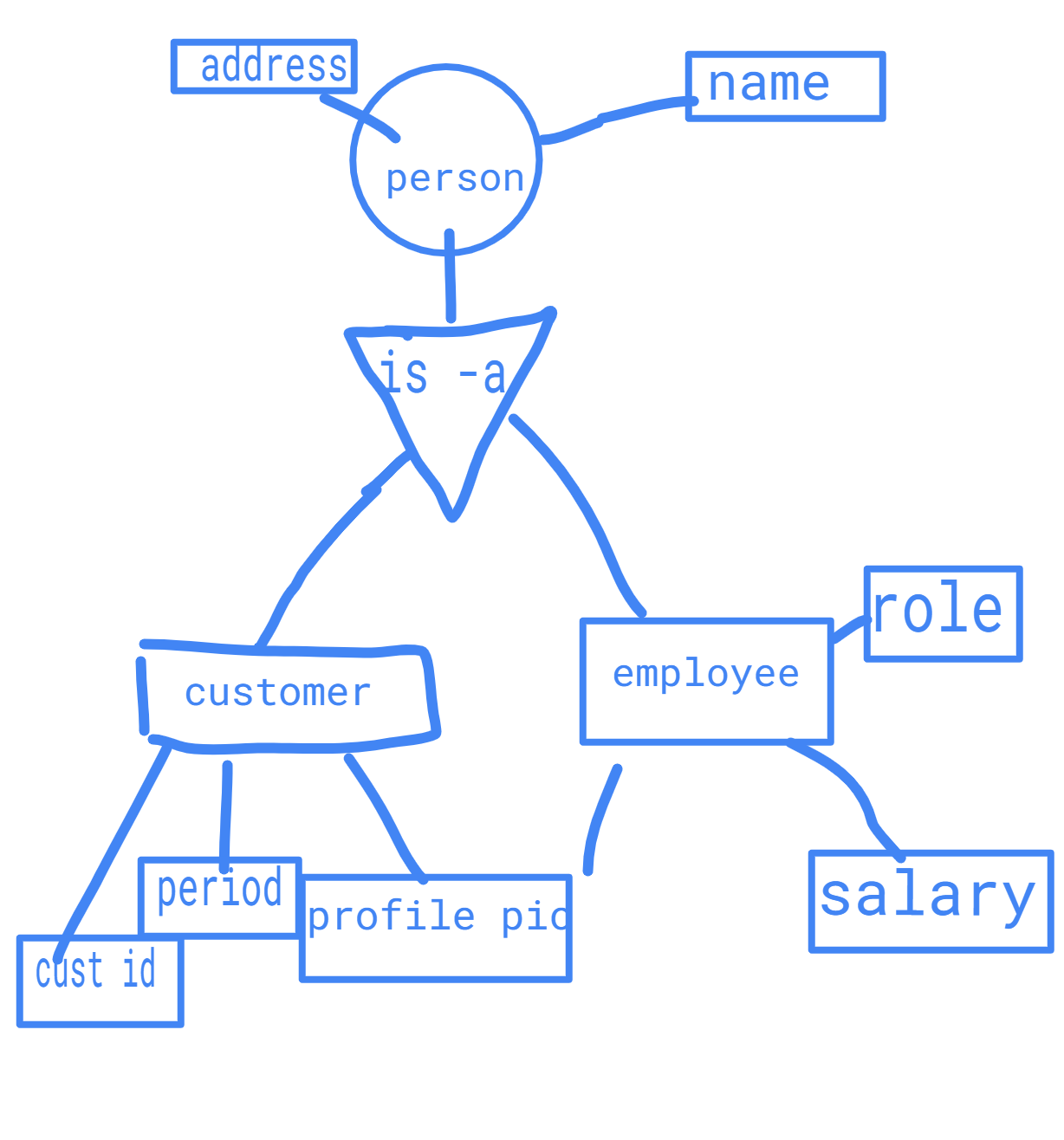
Example-Consider an entity Person with attributes:
- Name, Contact ,Address
Now, suppose this person can be:
A Customer (with attributes like Customer_ID, Profile_Picture)
An Employee (with attributes like Salary)
Keeping all these attributes in one PERSON entity causes redundancy and confusion.
Solution using Specialization
PERSON becomes the Superclass
CUSTOMER and EMPLOYEE become Subclasses
Subclasses inherit common attributes from PERSON
Each subclass has its own specific attributes
Summary
It is a top-down approach
Uses an IS-A relationship, represented by a triangle
Helps in breaking complex systems into manageable parts
Allows adding multiple specializations as the system grows
Acts as a refined blueprint for database design
2. Generalization
Generalization is the opposite of Specialization and follows a bottom-up approach.
Explanation-When multiple entities share common attributes, they can be combined into a single generalized entity to reduce redundancy.
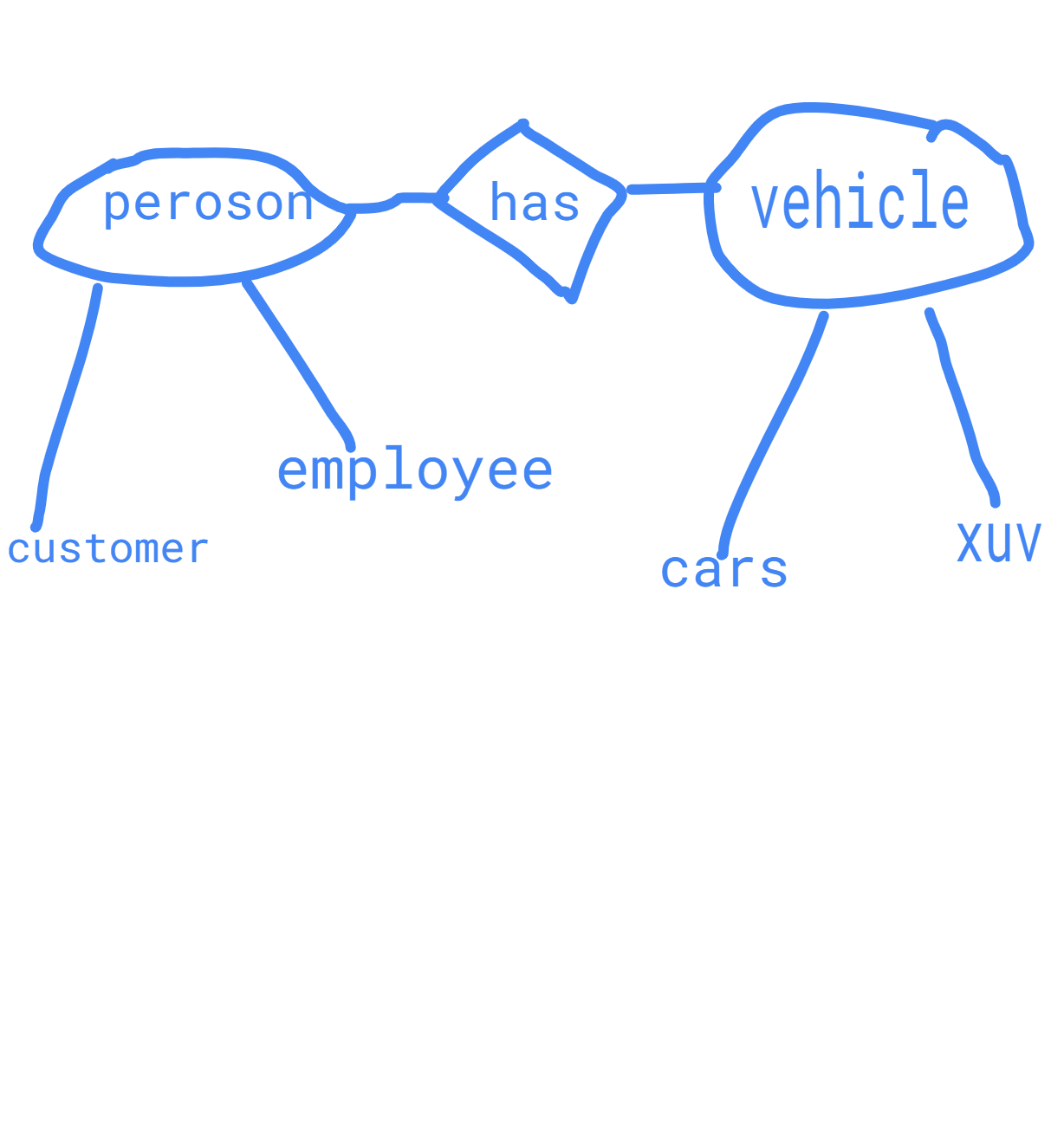
Example- Entities: Car, Bus, SUV
These entities may have overlapping attributes like:
- Vehicle_Number , Fuel_Type ,Capacity
Instead of repeating common attributes, they are generalized into a single entity called Vehicle.
SUMMMARY
Common attributes are merged into a parent entity
Uses IS-A relationship
Reduces attribute repetition
Makes the database simpler, cleaner, and more refined
Improves maintainability
**A. Participation & Inheritance-**If a parent entity participates in a relationship, its child entities automatically participate in that relationship.
Example- If: PERSON has a relationship with VEHICLE.Then: EMPLOYEE and CUSTOMER (children of Person) will also be related to VEHICLE. This is known as inheritance of participation.
3. Aggregation
Aggregation is used to represent a relationship between an entity and a group of related entities treated as a single unit.
Explanation-Sometimes, an entity does not interact with individual entities separately, but with them collectively. Representing individual relationships may cause redundancy and unnecessary complexity.
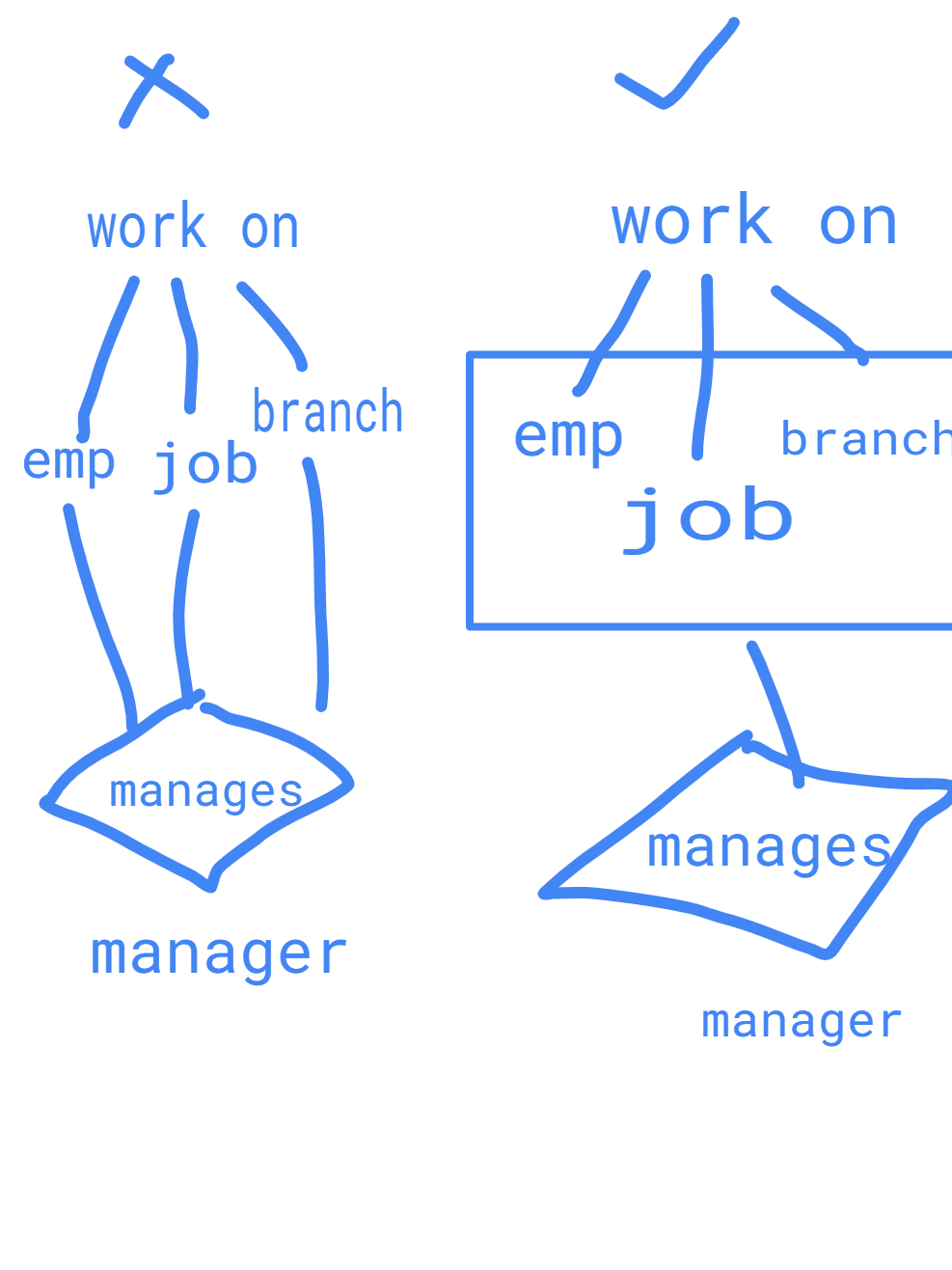
Example-A Manager manages :Employees, Branch, Job
Instead of creating separate relationships between Manager and each entity, we can:
Combine EMPLOYEE, BRANCH, and JOB into a single aggregated entity
Create one relationship: Manager manages Aggregation
Benefits
Hides internal complexity
Reduces redundancy
Introduces abstraction
Makes ER diagrams clearer and more meaningful
Conclusion
Specialization → Top-down, breaks complex entities into subclasses
Generalization → Bottom-up, merges common attributes into a superclass
Aggregation → Groups related entities into a single abstract unit
All three concepts help in designing a robust, efficient, and scalable database system.
Other Features of the ER Model-checkout here-https://database-sql-dbms.hashnode.dev/data-model-er-model
ER Uses entities to represent real-world objects
ER Uses attributes to describe properties of entities
Supports different types of attributes:
Simple
Composite
Single-valued
Multi-valued
Derived
NULL
Defines primary keys to uniquely identify entities
Represents relationships between entities
Supports different types of entities:
Strong entities
Weak entities
Supports different degrees of relationships:
Unary
Binary
Ternary
Enforces mapping cardinality constraints:
One-to-One
One-to-Many
Many-to-One
Many-to-Many
Supports participation constraints:
Total participation
Partial participation
Follow this steps to create ER diagram for your next project.
Identify entity set.
Identify attributes of the entites set -and their types (single ,muti varied)
Identify relationship and constraint -Mapping and Participation


